Annual Reports
Devon Energy Corporation's annual reports contain management's most considered account of the business. These are the sections, passages and visual pages worth opening in the originals preserved in Sources.
Devon Energy Corporation — FY2025 Annual Report (Form 10-K) — FY2025
The last 10-K Devon filed as a standalone company: full-year 2025 results plus the Coterra merger of equals signed 17 days before filing. · Open the full document →
Items 1 and 2. Business and Properties — p. 10 · Read the full section →
Devon in its own words, and the five principles it says govern capital allocation through the price cycle.
The self-description and two of the five stated principles: asset quality and cash back to shareholders.
Founded in 1971 and publicly held since 1988, Devon (NYSE: DVN) is an independent energy company engaged primarily in the exploration, development and production of oil, natural gas and NGLs. Our operations are concentrated in various onshore areas in the U.S. […] Our business strategy is focused on delivering a consistently competitive shareholder return among our peer group. Because the business of exploring for, developing and producing oil and natural gas is capital intensive, delivering sustainable, capital efficient cash flow growth is a key tenet to our success. While our cash flow is highly dependent on volatile and uncertain commodity prices, we pursue our strategy throughout all commodity price cycles with five fundamental principles. […] Advantaged asset portfolio – We believe U.S. crude oil and natural gas will continue to be advantaged in the global energy markets. As discussed in more detail later in this section, we own a portfolio of assets located in the Delaware Basin, Rockies, Eagle Ford and Anadarko Basin. We strive to own premier assets capable of generating cash flows in excess of our capital and operating requirements, as well as competitive rates of return. […] Delivering value to shareholders – We are committed to shareholder returns. We are dedicated to a growing fixed dividend that is sustainable through the commodity price cycles. We adhere to distributing our cash flows in excess of operating and capital needs to shareholders.
p. 10 · Read in context →
Oil and Gas Properties — Property Profiles — p. 16 · Read the full section →
One page fixes where the barrels come from: Delaware Basin is 59% of production and 56% of proved reserves.
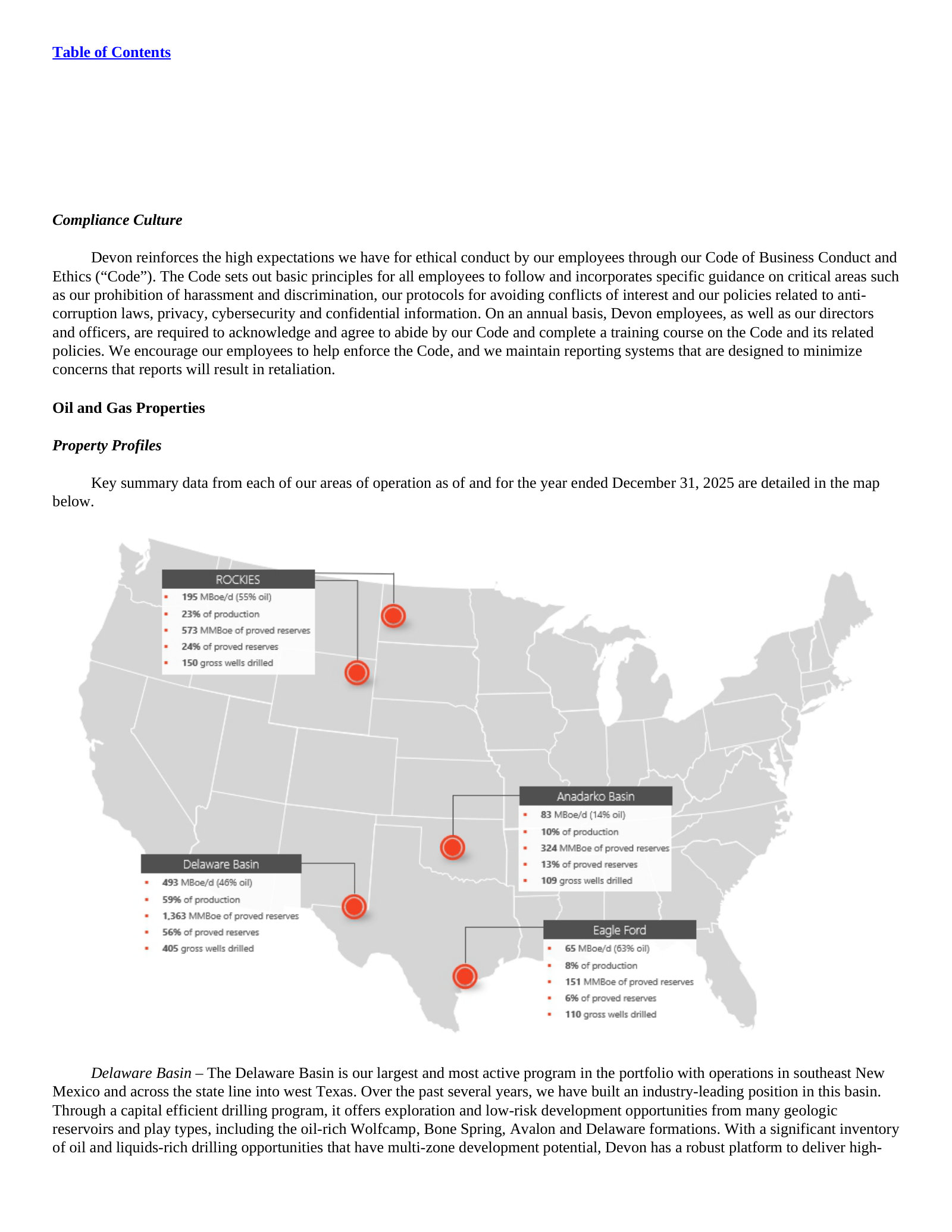
The three non-Delaware areas: Grayson Mill rebuilt the Rockies, BPX split the Eagle Ford, Dow co-funds the Anadarko.
Rockies – Our Rockies development consists of our Williston Basin and Powder River Basin assets. Our position within these oilweighted basins provides us with a deep inventory of high-margin opportunities. […] Through the Grayson Mill acquisition, we significantly expanded our operating position within the basin. […] Eagle Ford – Our Eagle Ford operations are located in Texas' DeWitt and Karnes counties, situated in the economic core of this south Texas play. Its production is leveraged to oil and has low-cost access to premium Gulf Coast pricing, providing for strong operating margins. On April 1, 2025, Devon and BPX Energy dissolved their partnership and divided their acreage in the Eagle Ford Blackhawk field located in Texas' DeWitt County, resulting in increased operational flexibility for both parties. […] Anadarko Basin – Our Anadarko Basin development, located in western Oklahoma, is one of the largest in the industry, providing substantial long-term inventory optionality. We have an agreement with Dow to jointly develop a portion of our Anadarko Basin acreage and, as of December 31, 2025, we had a two rig program associated with this joint venture.
p. 18 · Read in context →
Midstream Capacity Constraints and Interruptions Impact Commodity Sales — p. 33 · Read the full section →
Devon's gas realized 49% of Henry Hub in 2025 and Williston gas realized below zero; takeaway is where that value goes.
Risks Relating to the Merger — p. 41 · Read the full section →
A new risk category in this edition: the whole Coterra thesis rests on $1.0bn of synergies, and the deal could still have broken.
Integration risk, with the planned dividend increase and buyback authorization explicitly conditioned on realizing synergies.
The success of the Merger will depend on, among other things, the combined company’s ability to realize anticipated synergies and benefits. If the combined company is not able to successfully achieve these synergies, or the cost to achieve these synergies is greater than expected, then the anticipated benefits of the Merger may not be realized fully or at all or may take longer to realize than expected. Moreover, if we do not realize such benefits or for any other reason, the board of directors of the combined company may not approve, or delay the approval of, the anticipated increases in our dividends and share repurchase authorization following the Merger, which could negatively impact our stock price.
p. 41 · Read in context →
Item 7. Management's Discussion and Analysis — Executive Overview — p. 55 · Read the full section →
Management's own framing of the two years that reshaped the company: Grayson Mill, then Coterra, with a cost plan in between.
The $5.0bn Grayson Mill purchase, the Coterra merger of equals, and the $1.0bn business optimization plan.
On September 27, 2024, we acquired the Williston Basin business of Grayson Mill for total consideration of approximately $5.0 billion, consisting of $3.5 billion of cash and approximately 37.3 million shares of Devon common stock, including purchase price adjustments. […] On February 1, 2026, we entered into the Merger Agreement, providing for an all-stock merger of equals with Coterra. The Merger will create a leading large-cap shale operator with an asset base anchored by a premier position in the economic core of the Delaware Basin. The Merger is expected to unlock substantial value for shareholders by leveraging enhanced scale to improve margins, increase free cash flow and accelerate cash returns through the capture of $1.0 billion in sustainable annual synergies. […] To emphasize our commitment to maximizing free cash flow and creating value for shareholders, we have implemented a business optimization plan which is anticipated to improve our annual pre-tax cash flow by $1.0 billion. The plan includes actions to achieve more efficient field-level operations and improvements in drilling and completion costs while improving operating margins and corporate costs. These savings are on track to be achieved by the end of 2026 with approximately $850 million achieved through 2025.
p. 55 · Read in context →
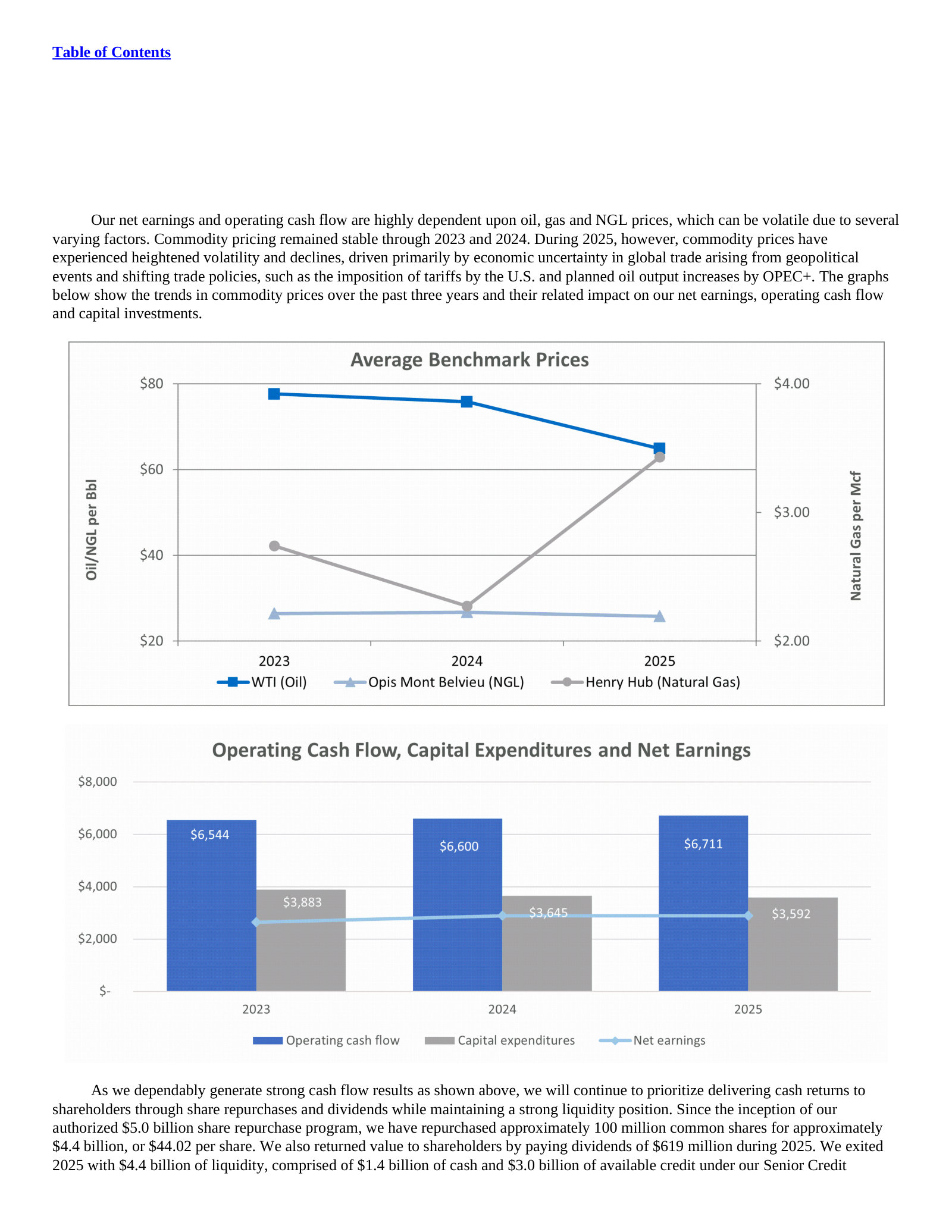
Results of Operations — p. 59 · Read the full section →
The clearest statement of what actually moved 2025: volumes up on Grayson Mill, prices down on WTI, DD&A up on both.
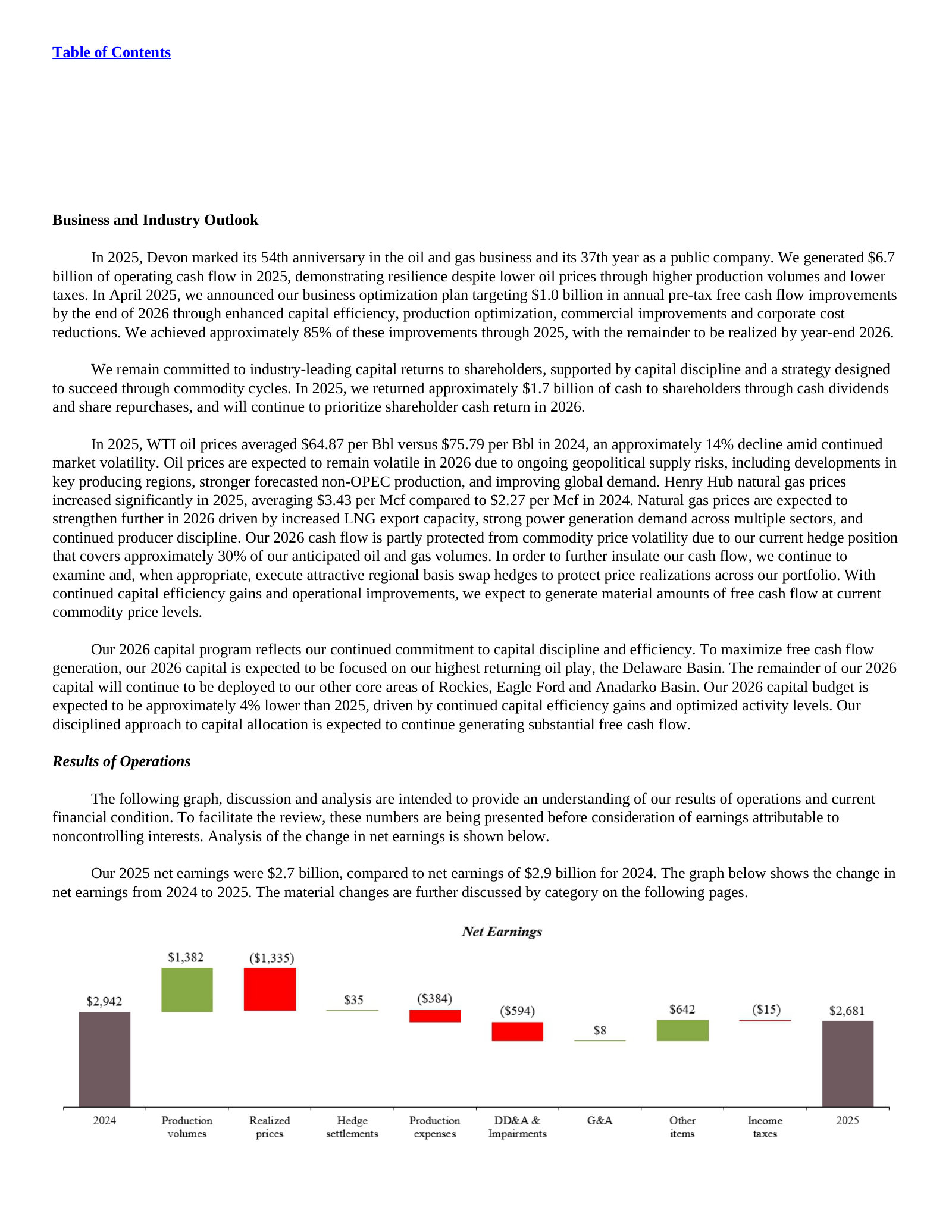
Why realized prices cost $1.3bn: lower WTI and Mont Belvieu, partly offset by higher Henry Hub and hedge settlements.
From 2024 to 2025, realized prices contributed to an approximately $1.3 billion decrease in earnings. This decrease was due to lower unhedged realized oil and NGL prices which decreased primarily due to lower WTI and Mont Belvieu index prices, respectively. This decrease was partially offset by an increase in unhedged realized gas prices which was primarily due to higher Henry Hub index prices. Realized prices were also positively impacted by oil, gas and NGL hedge cash settlements.
p. 63 · Read in context →
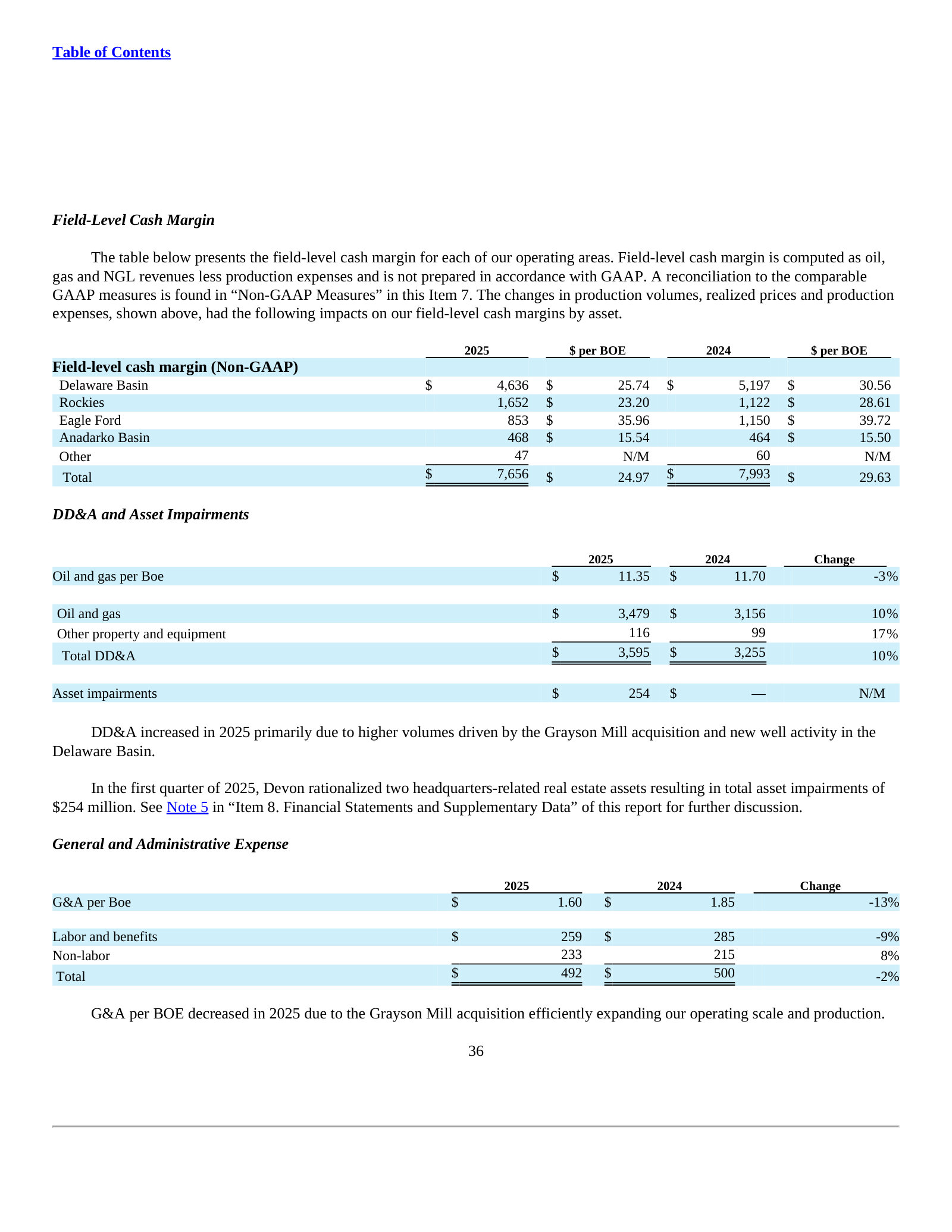
Field-Level Cash Margin — p. 65 · Read the full section →
Devon reports one segment, so this table is the only place the four operating areas are compared on unit economics.
Critical Accounting Estimates — p. 75 · Read the full section →
Successful-efforts accounting plus the reserve estimate set what gets capitalized and how fast it is depreciated.
Devon Energy Corporation — FY2021 Annual Report (Form 10-K) — FY2021
Included for contrast only: the WPX merger year, when Devon set out the fixed-plus-variable dividend that FY2025 no longer runs. · Open the full document →
Items 1 and 2. Business and Properties — p. 8 · Read the full section →
The previous merger of equals, and a strategy stated in four principles across five plays rather than five principles across four.
January 2021: the WPX all-stock merger of equals and the cash-return business model it was meant to accelerate.
On January 7, 2021, Devon and WPX completed an all-stock merger of equals. WPX was an oil and gas exploration and production company with assets in the Delaware Basin in Texas and New Mexico and the Williston Basin in North Dakota. This merger enhanced the scale of our operations, built a leading position in the Delaware Basin and accelerated our cash-return business model that prioritizes free cash flow generation and the return of capital to shareholders. […] While our cash flow is highly dependent on volatile and uncertain commodity prices, we pursue our strategy throughout all commodity price cycles with four fundamental principles. […] As a result of our recent Merger and acquisition and divestiture activity, our oil production, price realizations and field-level margins have continued to improve as we continue to sharpen our focus on five U.S. oil and liquids plays located in the Delaware Basin, Anadarko Basin, Williston Basin, Eagle Ford and Powder River Basin.
p. 8 · Read in context →
Item 5. Market for Common Equity, Related Stockholder Matters and Issuer Purchases of Equity Securities — p. 35 · Read the full section →
The fixed-plus-variable dividend as originally defined; FY2025 p.52 drops the variable half and leans on buybacks instead.
Payout mechanics as written in 2021: ~10% of operating cash flow fixed, plus up to 50% of excess free cash flow variable.
Following the closing of the Merger, Devon initiated a “fixed plus variable” dividend strategy. Under this strategy, Devon plans to pay, on a quarterly basis, a fixed dividend amount and, potentially, a variable dividend amount, if any, to its stockholders. […] In determining the amount of the quarterly fixed dividend, the Board expects to consider a number of factors, including Devon’s financial condition, the commodity price environment and a general target of paying out approximately 10% of operating cash flow through the fixed dividend. Any variable dividend amount will be determined on a quarterly basis and will equal up to 50% of “excess free cash flow,” which is a non-GAAP measure and is computed as operating cash flow (a GAAP measure) before balance sheet changes, less capital expenditures and the fixed dividend.
p. 35 · Read in context →
More annual reports
Devon Energy Corporation — FY2024 Annual Report (Form 10-K) — FY2024 · 175 pages · The Grayson Mill year: purchase accounting for the $5.0bn Williston acquisition, and the last edition to report variable dividends paid. · Open →
Devon Energy Corporation — FY2023 Annual Report (Form 10-K) — FY2023 · 174 pages · The pre-acquisition baseline: 658 MBoe/d and $3.8bn of net earnings, with the Anadarko still a significant field and no Williston. · Open →
Devon Energy Corporation — FY2022 Annual Report (Form 10-K) — FY2022 · 135 pages · Peak of the cycle and of the payout: $3.4bn of dividends, $2.9bn of it variable — what the old model returned at $94 WTI. · Open →